




 Medical for Child
We understand the unique needs of each child and are dedicated to providing personalized care and addressing all your concerns.

Jaundice Management
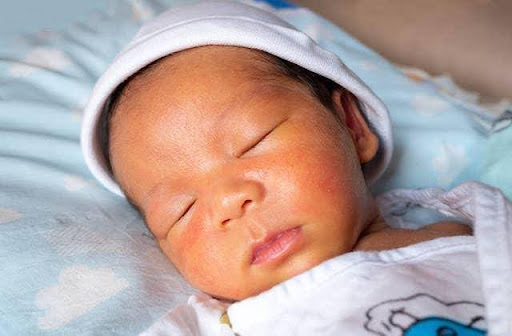
What is neonatal jaundice?
Jaundice is common in the newborn period and occurs due to the buildup of Bilirubin in the blood leading to yellowing of the skin and eyes. It is usually mild and clears as baby grows. However, if Bilirubin levels reach excessive levels, it may result in a rare but serious condition called Kernicterus where there is toxicity to brain tissue.
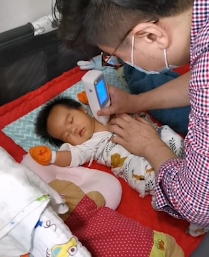
How do we check for jaundice?
We suggest checking for jaundice within the first week of life. At our clinic, we can monitor baby’s jaundice levels by checking Transcutaneous bilirubin levels (TcB). A handheld device is placed on baby’s chest to measure TcB levels. It is non-invasive and painless for baby. In some cases a heel prick to collect some of baby’s blood may also be done to check Serum bilirubin (SB) if required.

Childhood Developmental Assessments
Why are childhood developmental assessments needed?
Child Developmental Screening (CDS) is advised from birth to help identify any growth or developmental delays that would benefit from early intervention. The Ministry of Health (MOH) recommends regular developmental screenings at around 4 weeks, 4months, 6months, 12months, 18months, 30months and 48 months of age.
What is done at developmental assessments?
At each screening, we will monitor child’s growth, perform a physical check and developmental check. To reduce the number of visits needed, we usual try to schedule it together with your child’s immunization.
How much does it cost?
Each CDS costs $40, but for Singaporeans, they are fully subsidized by the Singapore government if done within MOH stipulated age ranges.

Childhood Immunisations
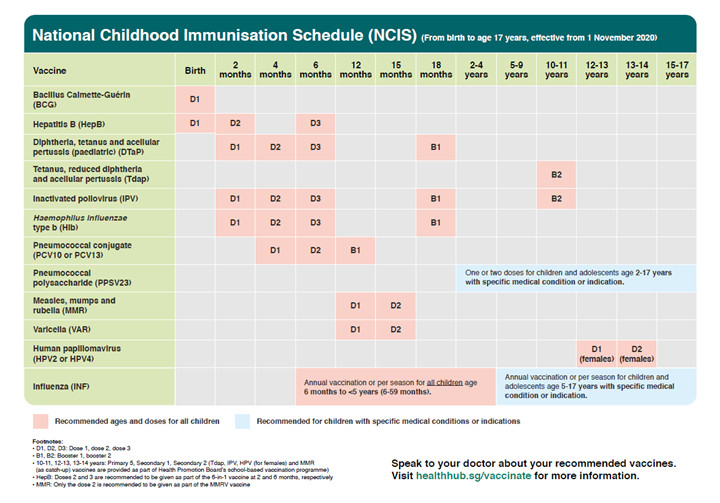
Which vaccinations does my child need?
In Singapore, children are recommended to get vaccinations based on the National Childhood Immunisation Schedule (NCIS).
The vaccinations in the NCIS cover your child against 14 different diseases, of which, Measles and Diphtheria are compulsory by law.
- Tuberculosis
- Hepatitis B
- Diphtheria
- Tetanus
- Pertussis
- Polio virus
- Haemophilus Influenza type B
- Pneumococcal
- Influenza
- Measles
- Mumps
- Rubella
- Varicella (Chickenpox)
- Human Papillomavirus
Optional vaccinations
- Rotavirus
- Hepatitis A
- Meningococcal
- Typhoid
We have combination vaccines, which allow multiple vaccines to be administered in one injection. Eg. 6-in-1 (Hepatitis B, Diphtheria, Tetanus, Pertussis, Polio virus, Haemophilus Influenza type B), MMRV (Measles, Mumps, Rubella, Varicella)
If you have upcoming travels plans, do speak to our doctors to help you create an individualized immunization plan that will protect your child optimally during your travels.
What can I expect after immunisation?
Common post vaccination side effects and how to manage them
-
Fever – give child plenty of fluids, dress child in light clothing, sponge
child with cool tap water, serve medications for fever -
Redness, swelling and soreness around injection site – apply cool pack/towel
to area, help child move their arm or leg several times a day, give medicine
to help them feel more comfortable
Specific vaccines
-
For Measles and Chickenpox vaccines, fever and rashes may appear 1-2 weeks
later. -
For Rotavirus vaccine, side effects are uncommon but include irritability
and diarrhea.
How much does it cost?
For Singaporeans, vaccinations under the NCIS are fully subsidized. Baby bonus or CDA can be used to pay for approved optional vaccines. For non-Singapore citizens, we have the option of vaccination packages.

Child Acute & Chronic Care
Expert Care for Common Conditions
We can follow up children for common conditions such as acne, constipation, asthma, allergic rhinitis, eczema & and other skin conditions.
Fast Diagnosis and Treatment
Children may fall sick frequently as their immune system is not yet robust. We are here to help you and your child through these worrying periods. We can treat a range of childhood illness and injuries as well as provide nebulisation, nasal suctioning, blood tests and rapid tests for quick diagnosis if needed.
PaedsENGAGE partner
We are a PaedsENGAGE partner clinic with KK Women’s and Children’s Hospital (KKH) and National University Hospital (NUH), if your child is assessed by our doctors to need referral to the Children’s Emergency, a $50 subsidy will be given on prevailing Children’s Emergency fees.
Get Medical Care Remotely or at Home
Understand how it works for your convenience
Telemedicine
We offer teleconsultations for suitable conditions. However, your safety is our priority, and some conditions may require in-person exams or tests.
Housecall
We offer housecalls for suitable conditions. However, your safety is our priority, and some conditions may require in-person exams or tests.